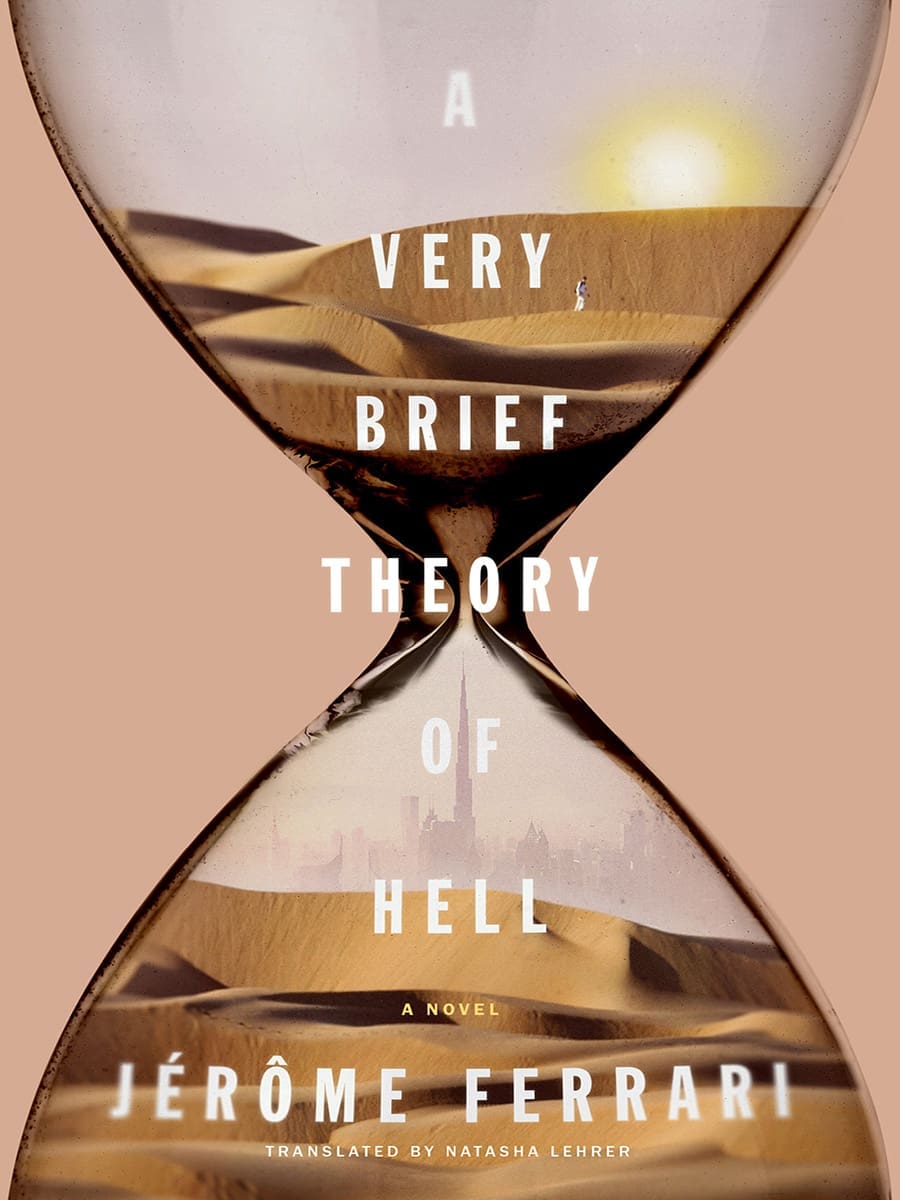
Prix Goncourt-winning author Jérôme Ferrari delivers a moving tale about the emotional void of modern exile. A Frenchman, driven by the desire to escape himself, takes a job at the French high school in Abu Dhabi and settles there with his wife and child. The family’s path soon crosses with that of a Sri Lankan immigrant who arrived in the Persian Gulf thirty years earlier and has been drifting from household to household to survive. Told with sharp lyricism, Ferrari’s novel of parallel lives is a heart-wrenching examination of a relationship between strangers. Expatriate and immigrant emerge as two different ways of being a foreigner in the oil-rich Emirates, one prosperous and the other impoverished, each wandering and seeking but separated from one another in a fashion that empathy cannot bridge.
Excerpt from A Very Brief Theory of Hell
Arriving in the industrial zone of Mussafah, after crossing the most southerly of the three bridges that span the inlet separating the island from the peninsula, is like coming upon another world, bathed in the hazy light of limbo and disturbing dreams. In the distance, on the highway that leads to oases and the border with Saudi Arabia, an unending line of trucks trembles in the vapors like a mirage, moves like a ghostly caravan toward the incinerators where, sheltered by the dunes, garbage from the city burns day and night. By this time of the afternoon, the sun no longer blazes, its incandescent disc has begun to slowly drop down to the horizon bristling with cranes, thrown into relief with the surreal clarity of a child’s drawing against the uniform pallor of the golden sky. The obstinate resistance of the desert whips up an ochre haze of sand and dust that hovers a meter above the road, blurring the shuddering contours of the line of buildings, factories, workshops, customer service centers as far as the eye can see. I drive slowly past with the sense that I’m traversing a fake world of holograms and reflections, in the hope that I’ll come across an auto body mechanic who’ll be lenient enough to fix my rear bumper even though I don’t have the police report without which no repair is authorized. As is always the case, the unpleasant eruption of an unforeseen mishap into the monotony of my life—in the modest form of a minor collision in the parking lot of a hotel near the Corniche—left me initially unable to think straight: ceding to the folly of my first instinct, I drove straight to Mussafah, and it’s only now—in other words, too late—that I realize the stupidity of my scheme, in a country where the certainty of penalties guarantees an obsessive respect for the rules by inuring potential transgressors more efficiently than any moral purity to the seductions of compassion or greed. All I want is to be home with my wife, whom I picture standing on the balcony watching the sun set over the mangrove forest, while my daughter plays on the kitchen floor at Kaveesha’s feet as she makes dinner; but instead I’ve been driving around for an hour in search of the road home, lost in a disconcerting maze of parallels and perpendiculars, despite the straightforward layout, offering no distinctive landmark to guide the lost traveler, and seeming to repeat the same motifs in an endless loop—buildings of brick or breeze-block dancing like ethereal abstractions in the glaring light, the cloud of sand and dust that floats above the orangey asphalt, the skeletal silhouette of distant cranes rising into the cloudless sky, the massive structure of Mussafah Bridge, which I was trying to reach but that kept slipping every time I thought I was getting close, the long, lateral line of flight, crossroads and signs pointing to nothing as if the space had suddenly slammed shut on itself and was holding me prisoner in its perverse geometry that I was apparently the only living creature to haunt, perhaps forever, in sadness and solitude. I’m about to give into panic when I spot ahead of me an indistinct shadow darkening the haze of sand that grows increasingly opaque as I approach, and eventually materializes into the serendipitous figure of a person walking in my direction. I draw up and lower the passenger window. He leans down against the car door and smiles amiably through the open window.
Can you point me in the direction of Mussafah Bridge? I’m trying to get home and I’m completely lost.
He looks at me, his long-suffering expression filled with brotherly compassion.
Me too, I’m also lost.
I nod and smile back. Where are you from?
Syria. You?
France.
We smile at each other without saying anything else.
Can I give you a lift?
He raises his shoulders. You don’t know where we are, or where I’m going. It wouldn’t be that simple.
He’s right, of course, so I shake the hand he holds out to me and tell myself I’ll find my way home with God’s help. I close the window. As I drive off, I watch him walk away in the rearview mirror until I can’t see him for dust and sand. I feel comforted at having shared a moment of friendship, however fleeting and superficial, with a fellow human being, and after a minute, at a crossroads that I can’t help thinking I’ve been over several times, I see a sign for Abu Dhabi. Perhaps I haven’t really crossed paths with a fellow human being after all, but with a celestial entity sent by divine mercy out of the great expanse of the desert to break the curse that condemned me to wander in this cursed place, that I might return to the loving embrace of my family—which would explain why the mysterious stranger was getting around on foot, a particularly incongruous means of locomotion in this country of air-conditioned vehicles, low-cost gas, and raging temperatures.