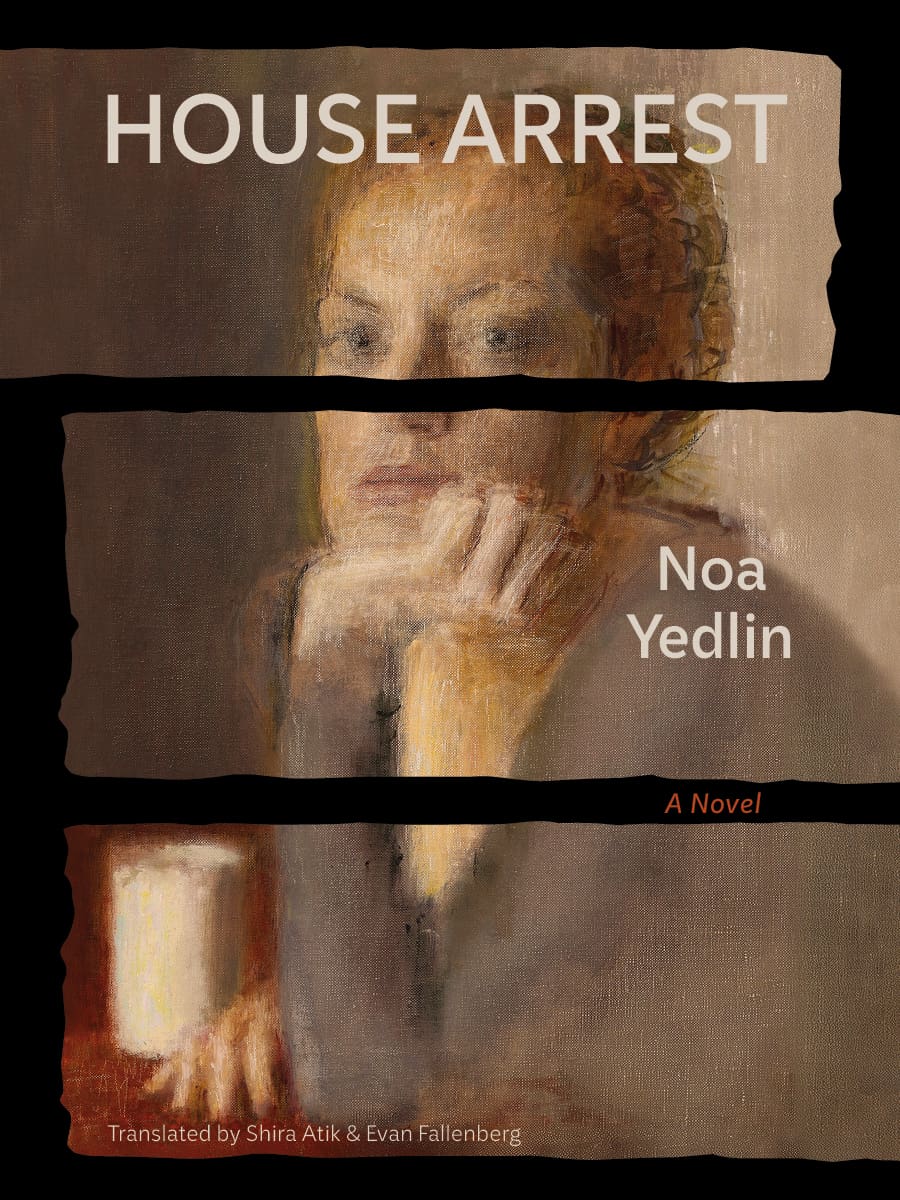
This prize-winning satirical novel chronicles a scandal that envelops a prominent Jerusalem family and leads to its downfall. The unsettling tale begins when Elisheva Fogel is accused of embezzling millions from the think tank she directs. Her three adult children try to close ranks, but old and new grievances surface, media scrutiny intensifies, romances inflame, and it’s hard to know who to trust anymore. On top of it all, it’s not just a renowned matriarch who comes under the microscope—everybody stands to lose financial and social capital. The allegation and its repercussions expose not only cracks in a heretofore esteemed clan, but plenty of hypocrisy throughout elite Israeli society. The novel has Noa Yedlin’s hallmark traits: richly detailed scenes and settings, piercing humor, and incisive social critique, all propelled by an immersive story.
Excerpt from House Arrest
From the outside, the house looked the same as always: imposing, self-confident, shamelessly claiming its share from a city that’s not big on giving. He looked for signs of change, but he found them only in the neighbors’ houses, which seemed to be shooting contemptuous glances at his parents’ house. The house on the right, 9 Elharizi, which had always been taller than Ben-Ami and Elisheva’s, now appeared to be gloating, holding itself aloft as if it had rightfully earned its stature. The house on the left, number 5, seemed to be flaunting its piousness, as if it was finally proving itself to its more glamorous neighbor.
For the first time in his life, Barak wished that his childhood home could camouflage itself, could bow its head and be absorbed into the quaint little street. But the street was so narrow that living there felt like a tremendous achievement, as if someone had hand-picked all the residents, and each house was so unique, so proud, that the very notion that it might feel ashamed of itself was inconceivable.
The houses were marked by good taste; instead of broadcasting their value from their front porches, they wore their worth with discretion, almost with modesty. The street was also fortunate enough to be spared the fate of other charming little streets, which had been overtaken by new residents for whom money wasn’t simply a pleasant soundtrack playing in the background but an ideology, and all it took was one such owner to ruin an entire street, especially in a city like Jerusalem.
The house was filled with light, which always surprised people when they came in from the Jerusalem fog, and which gracefully highlighted the contents of the house: the artwork in the living room (Rauschenberg, de Kooning) that Elisheva had insisted on renting from the museum even though she served on the board of directors and could have borrowed the paintings for free; the sofas and armchairs, the piano, the rugs—all old without being out of date. During the day, when the family was home alone, the furnishings shimmered in the bright, boastful light; as evening approached, and the danger of guests increased, the light grew weaker and the objects became more refined, cloaking their uniqueness in a veil of modesty befitting a house owned by refined people.
Now the house was dark, striking Barak, momentarily, as almost abandoned: outside of his imagination, there was no sign of the four, or maybe five, police officers—Barak had tried to count them several times, as if he was playing a computer game, trying to distinguish them despite their identical uniforms and their similar silhouettes, in an attempt to distract himself from the real issue, and, he later realized, to memorize their faces so that someday he could shoot them withering looks—walking up and down the short path to their house, carrying box after box like the cops on those TV shows that had been airing in reruns forever.
Then he tried to picture his mother’s office, and all the papers scattered around her house, everything that could qualify as “evidence,” as in, “The police are gathering evidence from the home of Elisheva Fogel,” and all of a sudden it seemed to him that there wasn’t a single piece of paper left in the entire house. He thought about his own house, about where all his papers could be found, charting a map in his mind, following an imaginary trail that led him to the message pad next to the telephone and to a huge pile of neglected pension statements and utility bills on the bookshelf in the foyer. But when he thought about his parents’ house, all he managed to dredge up was a single pathetic piece of paper on the refrigerator door, maybe an invitation to the grandchildren’s kindergarten graduation; other than that, nothing. For a minute he was horrified, as if the existence of scraps of paper, with their doodles and scribbles, could have attested to the fact that his parents were real people who wrote things down every now and then, and now the paperless house seemed to be closing in on him with a new kind of sterility he had never noticed before.
And then he remembered the wall of books, a huge wall lined with bookshelves that obscured the living room parameters, shelves that were such an integral part of the house that nobody even noticed them anymore. Towers of paper, with innumerable people, fingerprints, stories all bundled up inside.
Now, standing outside, he also remembered the second floor and the rooms he had hardly ever entered, like his mother’s study, and his father’s study, which had once been his sister’s room. If there were any papers in the house, that’s where they would most likely be found. Still, thinking of these unfamiliar rooms made him uncomfortable, perhaps because now he had to go into the house, alone.